8 Best Contact Form 7 Alternatives in 2026 (With a Real Visual Builder)
Contact Form 7 is the single most-installed form plugin on WordPress — over 10 million active sites — and also one of the most-searched-for "alternative to" queries in the category. Those two facts aren't in tension; they're the same story. It's the default choice because it's free, lightweight, and has existed forever, not because it's actually full-featured. The moment a site needs to see past submissions, show a field conditionally, or take a payment, Contact Form 7 has no native answer — and the fix most people reach for (bolt on another free add-on) usually isn't the actual fix.
Why people actually look for a Contact Form 7 alternative
Three gaps come up consistently, and they're structural, not edge cases:
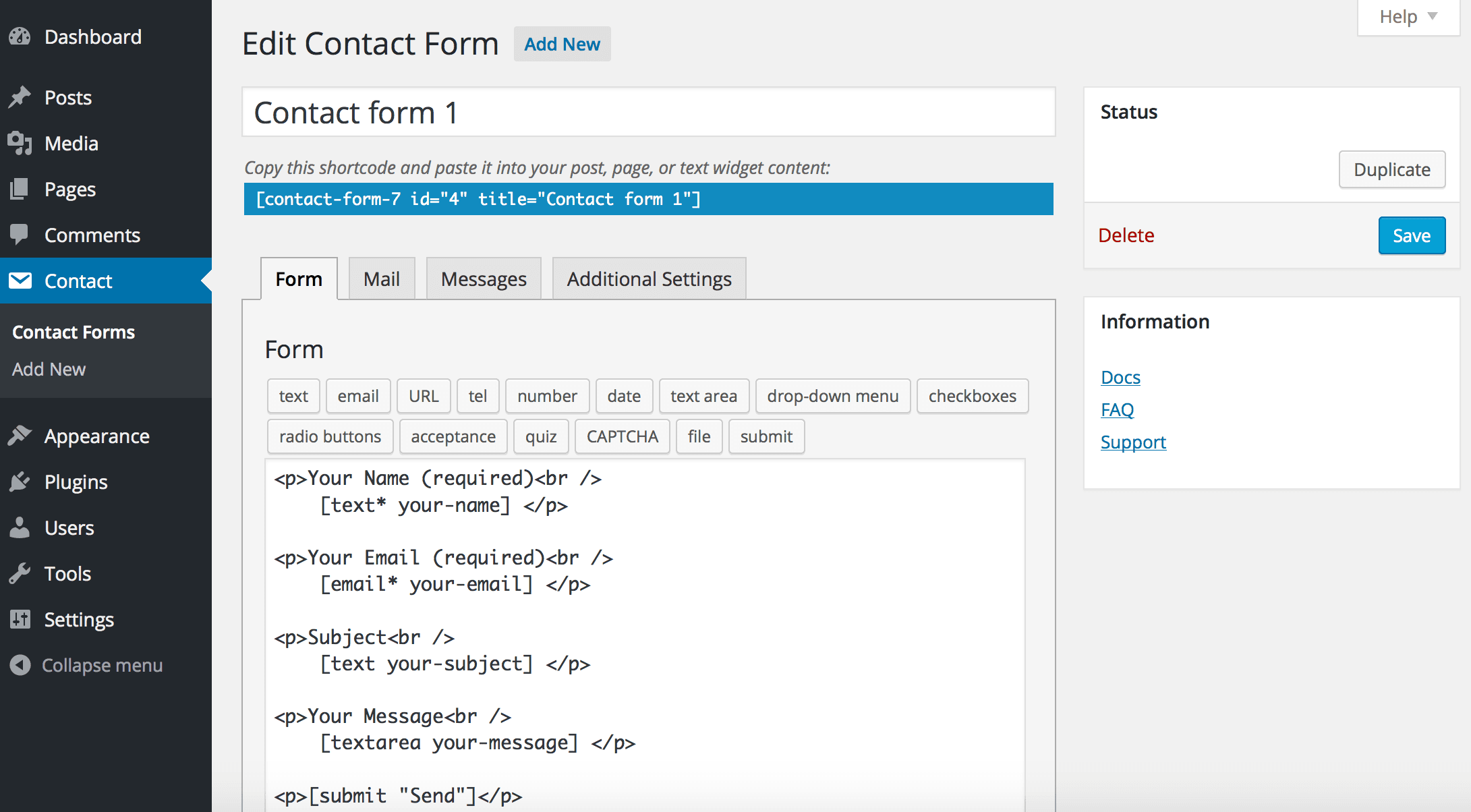
- No entry storage. Contact Form 7 emails a submission and discards it — there's no admin screen showing past submissions, no search, no CSV export. If that email gets marked as spam, lost, or the recipient address is ever wrong, the submission is simply gone, with no record it ever happened.
- No visual builder. Building or editing a form means editing raw shortcode-style markup directly —
[text* your-name],[email* your-email]— in a plain textarea, not dragging fields onto a canvas with a live preview. - No conditional logic or payments, core. Both require separate third-party add-ons, layered on top of an already-bare plugin, each with its own settings screen, its own update cycle, and its own compatibility risk with every other add-on in the stack.
None of this makes Contact Form 7 a bad plugin for what it actually is — a free, extremely lightweight way to get a "send me a message" form live in under a minute. It just means the honest use case is narrower than 10 million installs might suggest; a large share of those installs are sites that outgrew it years ago and never migrated.
The alternatives, compared
Every general-purpose alternative here includes a drag-and-drop builder and native entry storage — the two things Contact Form 7 lacks entirely. The real differentiation between them is conditional logic and payments, covered per-plugin below.
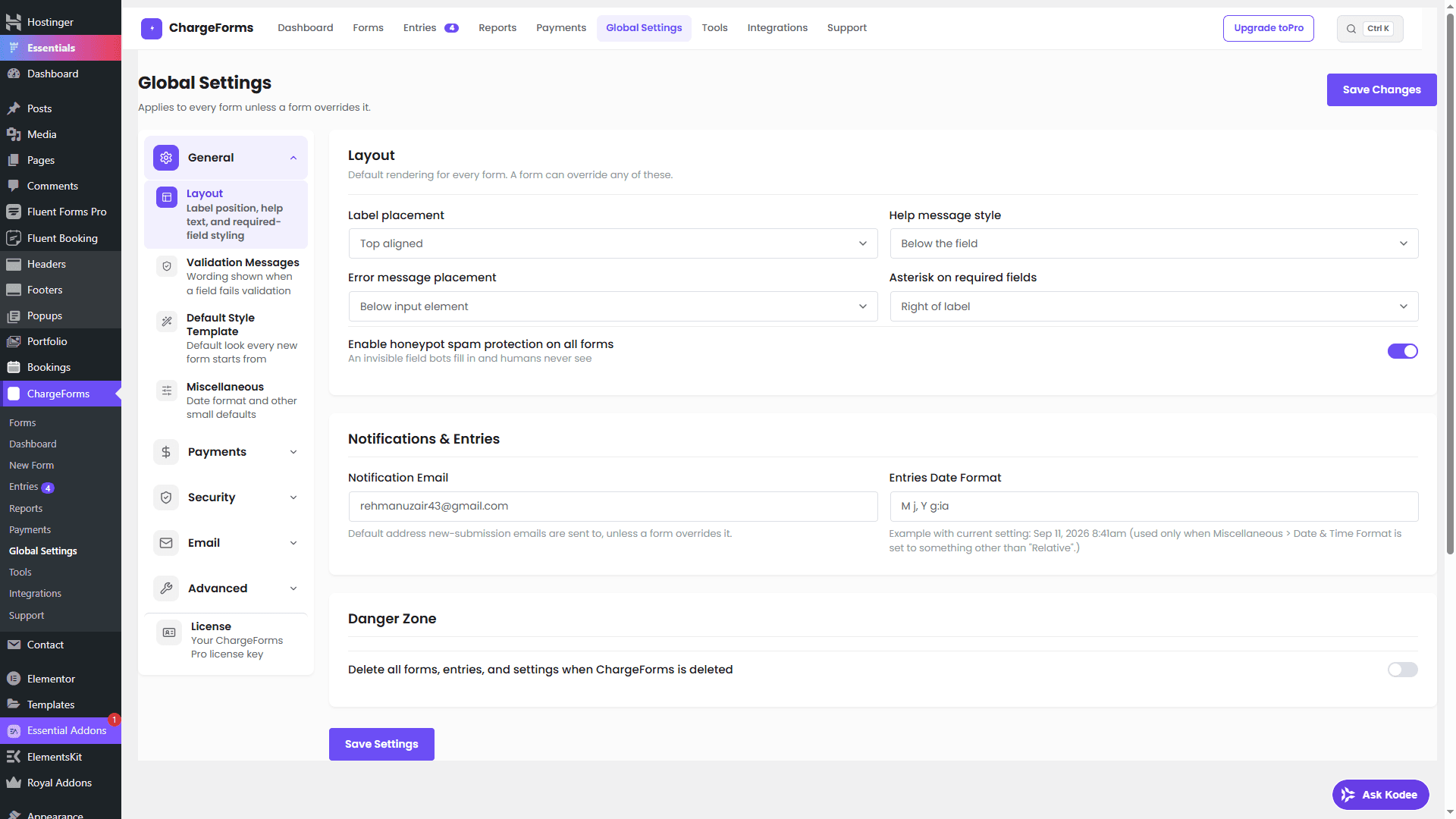
1. ChargeForms
Free plan includes a full drag-and-drop builder, native entry storage with CSV export, conditional logic (nested AND/OR/NOT), and Stripe/PayPal payments — the four things Contact Form 7 needs a separate plugin or add-on for, included together on one free plan with $0 platform fee.
Pricing: Free forever / $69/year (1 site) / $139/year (5 sites) / $259/year (unlimited).
Best for: Anyone leaving Contact Form 7 specifically because they needed entries, logic, or payments, and don't want to rebuild that functionality out of three separate add-ons.
Strengths: replaces Contact Form 7 plus Flamingo plus a conditional-logic add-on plus a payment add-on with one plugin, and every payment amount is verified server-side rather than trusted from the client. Trade-offs: newer to the market, so a smaller existing add-on ecosystem and fewer third-party tutorials than a decade-old plugin like Contact Form 7 has accumulated.
2. Fluent Forms
A free tier that includes conditional logic and a real visual builder, positioned similarly to WPForms but more generous on the free plan specifically.
Pricing: Free forever / $79 (1 site) / $159 (5 sites) / $299 (unlimited) per year.
Best for: Sites that need conditional logic free and can tolerate a 1.9% fee on Stripe payments (PayPal requires the paid plan).
Strengths: a large field library and a genuinely capable free tier. Trade-offs: the Stripe platform fee applies even on paid plans' base Stripe integration in some configurations — check current documentation for your specific plan before assuming payments are fee-free.
3. WPForms
The most template-heavy option here, and the plugin most people compare Contact Form 7 against directly, given both are extremely widely installed.
Pricing: Lite is free but excludes conditional logic and payments entirely; paid plans start at $99/year. See our full WPForms alternatives comparison for the complete tier breakdown.
Best for: Beginners who want the largest template library and don't mind paying once they need logic or payments.
Strengths: the gentlest learning curve of any option on this list, backed by the largest tutorial/template ecosystem after Contact Form 7 itself. Trade-offs: the free Lite tier is arguably not meaningfully more capable than Contact Form 7 for the specific gaps driving this search — conditional logic and payments both require paying.
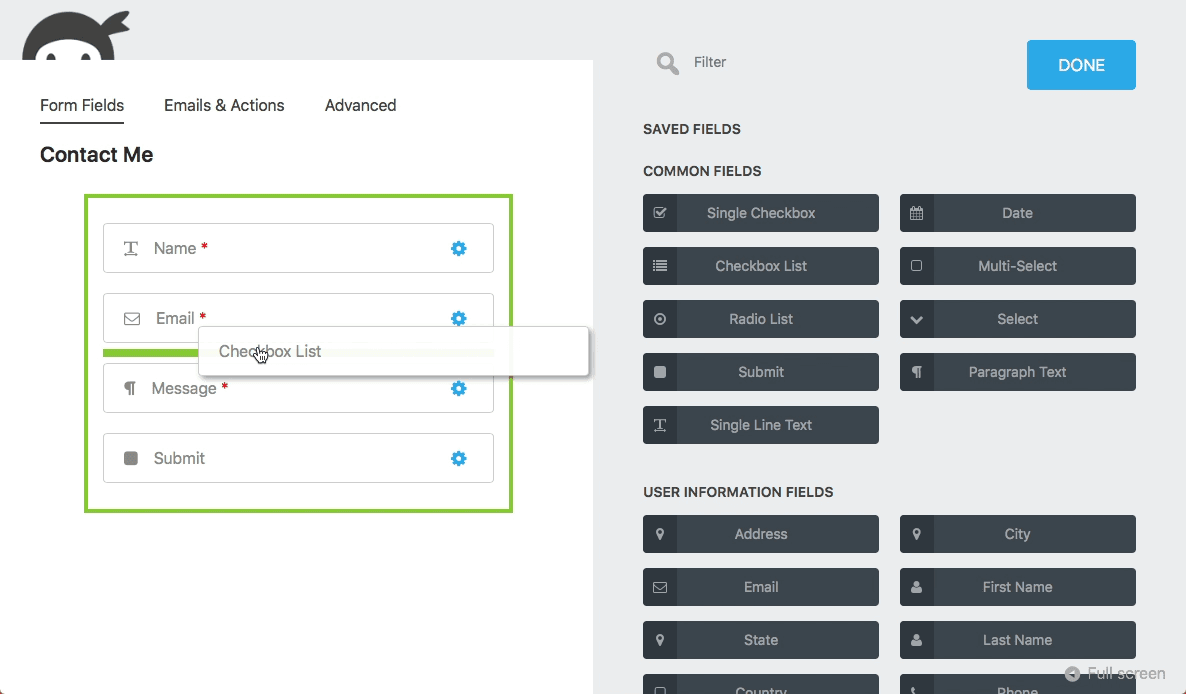
4. Ninja Forms
A genuinely usable free "Core" plugin with a real drag-and-drop builder and native entry storage — the two biggest gaps versus Contact Form 7 — though conditional logic depth and payments still require a paid add-on.
Pricing: Free Core / $99/year (3 sites) / $199/year (20 sites) / $499/year (unlimited).
Best for: Simple lead-generation forms where entries and a real builder matter more than logic or payments right now.
Strengths: unlimited site installs on the free plugin, and entries are stored natively without needing a Flamingo-equivalent add-on. Trade-offs: payments and deeper conditional logic still sit behind a paid upgrade, same gap as Contact Form 7 just moved one layer up.
5. Gravity Forms
No free tier, but the most mature, developer-extensible option here, with the largest third-party add-on ecosystem of any plugin in this category.
Pricing: No free tier. See the full comparison for exact current pricing.
Best for: Developers and agencies building custom integrations who were only using Contact Form 7 for its zero cost, not its simplicity.
Strengths: genuine hook-based extensibility and real documentation aimed at developers. Trade-offs: paying anything is a bigger jump from Contact Form 7's $0 than any other option here.
6. Formidable Forms
Built for data-heavy forms — calculations, front-end content display from submitted data — rather than a simple contact form, which is a meaningfully different use case than what most Contact Form 7 sites actually need.
Pricing: Free / $79/year (1 site) and up.
Best for: Sites that have outgrown "contact form" entirely and need something closer to a lightweight database front end.
Strengths: genuinely differentiated for complex data collection. Trade-offs: more builder complexity than a straightforward contact-form replacement needs.
7. Forminator
A free, broad-feature builder from WPMU DEV including basic payments and calculations free. Worth noting: Forminator had a critical file-upload vulnerability disclosed in 2026 (CVE-2026-15748), patched in 1.56.2 — confirm you're on a current version before switching to it.
Best for: Sites wanting a broad free feature set and comfortable confirming automatic updates are genuinely active.
Strengths: more included free than most competitors here. Trade-offs: the 2026 CVE history is worth factoring into the decision, even post-patch.
8. Jetpack Forms
Free if you're already running the broader Jetpack plugin suite for other reasons (security, stats, performance) — a basic but real visual builder with native entries, no extra plugin needed if Jetpack's already installed.
Best for: Sites already on Jetpack, wanting a simple upgrade over Contact Form 7 without adding a dedicated new plugin.
Strengths: zero additional plugin overhead if Jetpack is already active, maintained by Automattic. Trade-offs: conditional logic and payments are both shallow to absent — not a real competitor to dedicated form plugins on feature depth, only on convenience.
Why "just add a Contact Form 7 add-on" usually isn't the actual fix
The instinctive first move — Contact Form 7 works fine, just bolt on Flamingo for entries, a conditional-logic add-on, and a payment add-on — feels lower-effort than switching plugins entirely. In practice it usually isn't:
- Four separate plugins to update and keep compatible, instead of one, each maintained by a different author on a different release schedule.
- No single settings screen — entries live in Flamingo, logic lives in whatever add-on you picked, payments live in a third, and none of them share configuration or design language with each other.
- No guarantee any given add-on is actively maintained. Contact Form 7's own ecosystem includes a long tail of third-party add-ons with inconsistent update history — worth checking last-updated dates specifically before depending on one for payments.
Stitching together four plugins to match what a single modern form plugin does out of the box is more total maintenance surface, not less, even though each individual add-on install feels like the smaller step in the moment.
Pricing side by side
Regular annual list prices, gathered from each vendor's own pricing page at time of writing — verify current pricing before deciding, since these change over time.
Actually migrating away from Contact Form 7
- Export anything Flamingo has stored, if you installed it — Flamingo supports CSV export of its stored messages, and it's worth doing this before removing anything even if you don't have an immediate need for the historical data.
- Rebuild the form in the new plugin's visual builder rather than trying to migrate shortcode markup automatically — most Contact Form 7 forms are simple enough (name, email, message) that this takes minutes, not hours.
- Replace each add-on in your current stack explicitly — if you're using Flamingo, a conditional-logic add-on, or a payment add-on, confirm the new plugin's native equivalent actually covers what each one did before deactivating the old stack.
- Update the shortcode on every page and post referencing the old Contact Form 7 form — this is the step most commonly forgotten, and it's usually a site visitor, not the site owner, who discovers a broken form first.
- Re-test email notifications specifically. Contact Form 7's mail configuration is famously easy to misconfigure (mismatched "from" addresses landing in spam) — confirm the new plugin's notification emails are actually arriving, not just that the form submits successfully.
- Keep Contact Form 7 active but unlinked briefly during the transition if your setup allows it, so you can compare old and new form behavior side by side before fully committing.
The bottom line
Contact Form 7's install count reflects how long it's existed and how little it costs to try, not how complete it is — no native entry storage, no visual builder, no conditional logic, and no payments are all real, structural gaps, not missing polish. If you're hitting any of those three specifically, the fix that actually reduces long-term maintenance is a plugin that includes them natively, not a fourth plugin stacked on top of Contact Form 7 to patch one gap at a time. See ChargeForms vs. WPForms for a detailed head-to-head if you're also weighing the more feature-complete free options against each other, not just against Contact Form 7.
Frequently asked questions
Does Contact Form 7 save form submissions anywhere?
Not by default. Contact Form 7 emails a submission and then discards it — there's no built-in entries database, no way to see past submissions in your WordPress admin, and no CSV export. Flamingo, a free companion plugin by the same author, adds that missing piece, but it's a second plugin to install and maintain, not something Contact Form 7 does on its own.
Does Contact Form 7 support conditional logic?
Not natively. Showing or hiding a field based on an earlier answer requires a separate third-party add-on (several free options exist, quality and maintenance status vary), rather than a built-in feature in Contact Form 7 core.
Can I accept payments with Contact Form 7?
Not without a separate payment add-on — Contact Form 7 core has no Stripe, PayPal, or any payment field at all. A dedicated add-on or plugin is required, and most of the actively maintained free options are limited (one-time payments only, no server-side amount verification in some cases) compared to a form plugin with payments built in from the start.
Why is Contact Form 7 still the most-installed WordPress form plugin if it's this basic?
Mostly inertia and simplicity for the narrowest use case. It's genuinely the fastest thing to install for a single, simple "send me a message" form, it's completely free with no upsell, it's extremely lightweight, and a decade-plus of tutorials and theme integrations assume it's already there. For that one specific job — a bare contact form with no logic, no payments, no entry management — it still does the job. The moment you need any of those three things, the calculus changes.
Is switching away from Contact Form 7 difficult?
Mechanically, no — most sites using Contact Form 7 have simple forms (name, email, message) that take minutes to rebuild in a new plugin's visual builder. The main friction is usually the add-on stack layered on top over time (Flamingo for entries, a third-party conditional logic add-on, a spam plugin), which doesn't migrate automatically and needs to be replaced with whatever the new plugin includes natively.
Related posts
Contact Form 7 Is in Maintenance Mode: What That Actually Means
Contact Form 7's creator confirmed at WordCamp Asia 2026 that version 6.2 is the last feature release — the plugin now gets security patches only. Here's what changes, what doesn't, and what to actually do about it.