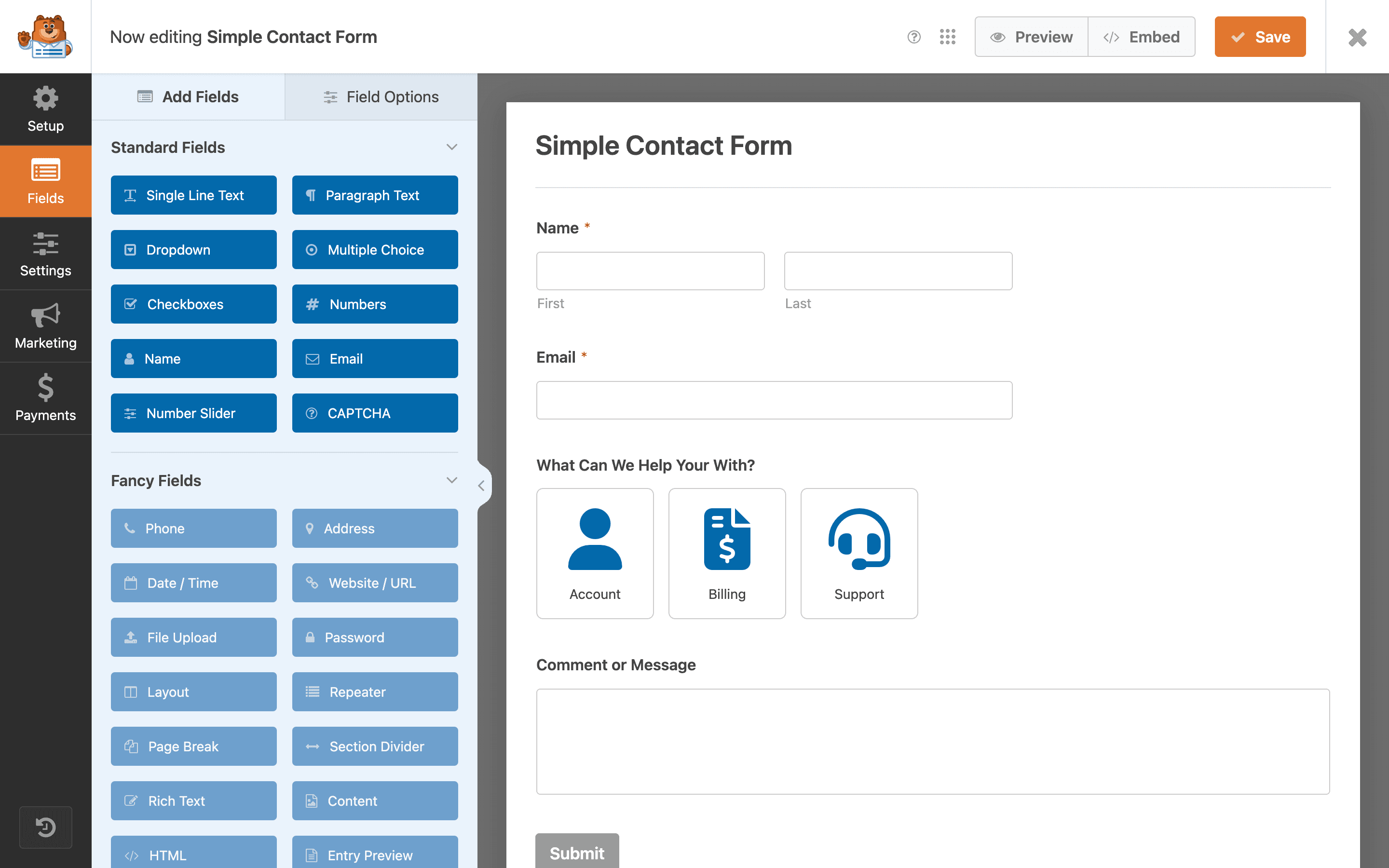
8 Best WPForms Alternatives in 2026 (Free and Paid, Compared)
WPForms is one of the most-installed WordPress form plugins, and it's a reasonable choice for a lot of sites — but it's not the only option, and for several common needs (conditional logic on a free plan, payments without an extra fee, deeper developer extensibility) it isn't the strongest one. This is a real, sourced comparison of the top alternatives, covering exactly where each one beats WPForms and where WPForms is still the better pick.
Why people actually look for a WPForms alternative
Three reasons come up consistently:
- WPForms Lite is very limited. The free plan doesn't include conditional logic, payments, or file uploads — it's a genuinely basic contact-form builder, positioned deliberately as a lead-in to the paid plans rather than a complete free tool.
- The platform fee. WPForms adds its own 3% fee on top of Stripe's own processing rate on Lite and Basic plans specifically — documented directly in WPForms' own help docs, and higher than any other major competitor's equivalent markup.
- Price at comparable tiers. WPForms' paid plans run higher than several alternatives at similar site-count tiers, covered in the pricing comparison below.
None of this makes WPForms a bad plugin — it's genuinely easy to use and has the largest template library in the category — but it does mean the "best form plugin" answer depends heavily on which of these specifically matters to you.
The alternatives, compared
"Free logic" = conditional logic on the free/lowest tier. "Free payments" = payment collection on the free tier — Fluent Forms marked partial since Stripe is free but with a 1.9% fee, and PayPal isn't available free at all.
1. Fluent Forms
The closest like-for-like alternative — a free-first positioning similar to WPForms' pricing structure, but a more generous free tier. Conditional logic, a large field library, and basic multi-step forms are all free. Stripe payments are also free, with a 1.9% platform fee; PayPal, Mollie, and Razorpay require Pro.
Pricing: Free forever / $79 (1 site) / $159 (5 sites) / $299 (unlimited) per year.
Best for: Sites that need conditional logic or basic multi-step forms without paying, and don't mind the Stripe fee or can upgrade to remove it once payment volume justifies it.
Strengths: the most generous free-tier feature set of any WPForms-style (free-first) competitor, a large field library, and tight integration with other WPManageNinja products (FluentCRM, FluentSMTP) if you're already using those. Trade-offs: a steeper initial learning curve than WPForms for a first-time builder, and the Stripe fee is a real cost at meaningful payment volume — see the full fee breakdown for exact numbers at your own volume.
2. Gravity Forms
The developer-focused choice — no free tier at all, but a mature, heavily-extensible plugin with the largest third-party add-on ecosystem of any option here. No platform fee markup on Stripe payments.

Pricing: No free tier. $59/year (1 site) / $159/year (3 sites) / $259/year (unlimited), per the full comparison.
Best for: Developers and agencies who want deep hook-based extensibility and are already committed to paying for a form plugin regardless of which one.
Strengths: the largest, most mature third-party add-on ecosystem of any plugin in this list, real developer documentation, and no percentage fee eating into payment volume. Trade-offs: zero free tier means there's no way to try it without paying first, and its interface leans more toward a technical audience than WPForms' beginner-friendly builder.
3. Ninja Forms
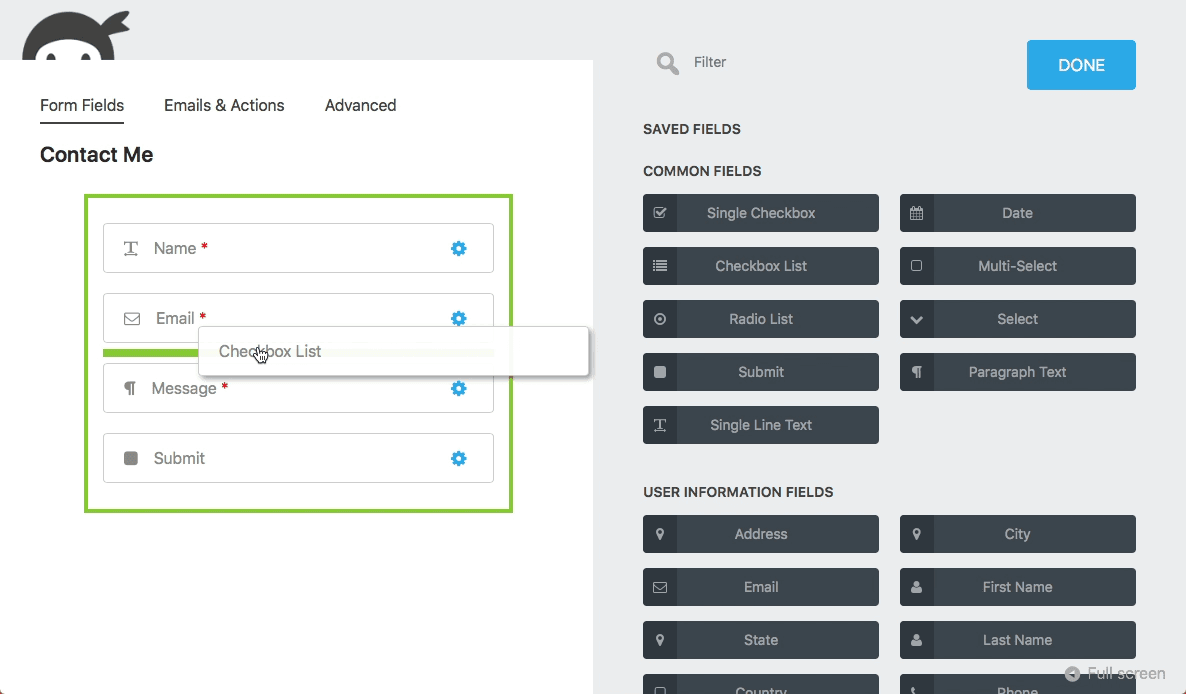
A genuinely usable free "Core" plugin — unlimited forms, a real drag-and-drop builder — but payments and conditional logic depth both require a paid add-on or plan.
Pricing: Free Core / $99/year (3 sites) / $199/year (20 sites) / $499/year (unlimited).
Best for: Simple lead-generation and contact forms on a budget, where payments and advanced logic aren't needed yet.
Strengths: unlimited site installs even on the free Core plugin (many competitors cap this or don't specify), and a straightforward, uncluttered builder. Trade-offs: the gap between what Core offers free and what the paid add-ons unlock is fairly wide — conditional logic and payments both require an upgrade, which somewhat undercuts the "free and complete" pitch for anything beyond a basic form.
4. Formidable Forms
Positions itself toward more complex, data-heavy forms (calculations, views, directories built from form data) rather than simple contact forms. Free tier is real but payments require the Business tier and up.
Pricing: Free / $79/year (1 site) / $199/year (3 sites) / $399/year (7 sites) / $599/year (unlimited).
Best for: Sites building complex data-collection tools beyond a standard contact form — directories, calculators, front-end content submission.
Strengths: genuinely differentiated capability for data-heavy use cases (Views lets you display submitted form data back on the front end, like a directory or listings page built entirely from form submissions) that none of the other plugins here directly replicate. Trade-offs: that same power means more complexity for a team that just needs a simple contact form — a straightforward use case gets more builder surface area than it needs.
5. WP Simple Pay
Not a general-purpose form builder — a dedicated Stripe payment forms plugin. Worth including specifically if payments are your only real requirement and you don't need a general contact-form builder alongside it.
Best for: A single-purpose payment or donation button/form, not a full form-builder replacement.
Strengths: purpose-built specifically for Stripe payment collection, which shows in a more polished payment-specific configuration experience than a general form builder's payment field bolted on as one feature among many. Trade-offs: not a substitute for a general contact-form builder — a site needing both payment forms and a regular contact form ends up running two plugins rather than one.
6. Jetpack Forms (formerly Contact Form 7 successor path / Crowdsignal-adjacent)
Bundled free with the broader Jetpack plugin suite for sites already using Jetpack for other features (security, performance, stats). Genuinely free, but shallower on advanced logic and payments compared to dedicated form plugins.
Best for: Sites already running Jetpack for other reasons, wanting a basic form without adding a second dedicated plugin.
Strengths: zero additional plugin overhead if Jetpack is already installed, and it's maintained by Automattic (WordPress.com's parent company), which counts for a lot on update reliability and long-term support confidence. Trade-offs: conditional logic, payments, and multi-step support are all shallower than dedicated form-builder plugins — it's genuinely a "basic form" tool, not a competitor to the rest of this list on feature depth.
7. Forminator
A free, feature-rich builder from WPMU DEV, including basic payments and calculations on the free tier. Worth noting: Forminator had a critical file-upload vulnerability disclosed in 2026 (CVE-2026-15748), fixed in version 1.56.2 — if you're considering it, confirm you're on a current, patched version.
Best for: Sites wanting a broad free feature set, provided the plugin is kept updated promptly given its 2026 disclosure history.
Strengths: a genuinely broad free feature set including basic payments and calculations, which is more than most free-tier competitors offer at once. Trade-offs: the 2026 critical vulnerability specifically involved a common field combination (File Upload + Select), which is worth factoring into risk assessment even post-patch — a plugin with a recent critical CVE isn't automatically less trustworthy going forward, but it's a reasonable prompt to confirm automatic updates are genuinely enabled, not just assumed to be.
8. ChargeForms
Free plan includes conditional logic (nested AND/OR/NOT), Stripe and PayPal payments — including Stripe subscriptions — multi-step forms, and CSV export — with $0 platform fee on payments at any tier.
Pricing: Free forever / $69/year (1 site) / $139/year (5 sites) / $259/year (unlimited) — see the full comparison against WPForms specifically.
Best for: Sites that need payments and conditional logic without paying anything, and specifically want to avoid a percentage-based fee on payment collection.
Strengths: the free tier includes both payments and conditional logic together, which no other free-tier competitor in this list matches at once (Fluent Forms has logic but a fee on payments; the rest lack one or both entirely) — and every payment amount is recalculated server-side rather than trusted from the client, closing the tampering vector some plugins leave open. Trade-offs: newer to the market than the established plugins here, so a smaller existing user base and add-on ecosystem than Gravity Forms or WPForms have built up over years; PayPal subscriptions specifically aren't implemented yet (Stripe subscriptions are, free on any plan).
How these were evaluated
Every pricing figure above is each vendor's own currently-published regular annual list price, not a promotional or introductory rate, gathered directly from their own pricing pages rather than third-party aggregators. Feature claims (what's included on a free tier specifically, versus what requires upgrading) are verified against each plugin's own documentation, not just its marketing homepage — a distinction that matters, since a feature listed prominently on a homepage doesn't always specify which tier it actually requires. Where a specific number (like WPForms' 3% fee, or Forminator's CVE) is stated, it's sourced from that vendor's own documentation or a credible independent security source, linked inline.
Choosing by use case
If you're deciding based on a specific, concrete need rather than a general "which is best" comparison, these tend to map cleanly:
- Simple contact form, budget zero, no payments needed: Ninja Forms Core, or Jetpack Forms if already running Jetpack.
- Need conditional logic free, payments can wait: Fluent Forms.
- Need payments free with no percentage fee: ChargeForms.
- Building something beyond a form — a directory, a calculator, front-end content submission: Formidable Forms.
- Already paying for a form plugin and want the deepest developer extensibility: Gravity Forms.
- Payments only, no general contact form needed: WP Simple Pay.
- Want the largest template library and gentlest learning curve, budget isn't the main constraint: stick with WPForms — it's genuinely the right call for this specific priority, even in an article about alternatives to it.
Pricing side by side
Regular annual list prices, not promotional rates — gathered from each vendor's own pricing page at time of writing. Verify current pricing directly before deciding, since these change over time.
What to actually check before switching
Migrating away from WPForms (or choosing among these instead of it from scratch) is worth deciding on the basis of a few specific, concrete checks rather than general reputation:
- Does the free tier of the alternative actually include what WPForms Lite doesn't — conditional logic, payments, file uploads — that's driving you to look in the first place? Confirm against the plugin's own current documentation, not just a comparison table (including this one), since free-tier feature sets change over time.
- Is there a platform fee, and if so, does it beat WPForms' 3% at your actual payment volume? Run the math with your own numbers rather than assuming any "no fee" option is automatically cheaper once a mandatory paid plan is factored in (Gravity Forms and Ninja Forms both require paying before Stripe works at all).
- What's the migration path for existing form data? Most of these plugins store entries in their own database tables with no native one-click import from a competitor — for most sites, rebuilding forms from scratch is faster than trying to migrate historical entries, especially for simple lead-gen or contact forms.
- Does the alternative's ecosystem match your actual needs — Gravity Forms' add-on marketplace and hook-based extensibility matter enormously for a developer-built custom integration and not at all for someone who just needs a working contact form.
Actually migrating away from WPForms
If you've decided to switch, the practical process is more mechanical than most people expect:
- Export what you can first. Most form plugins, WPForms included, support exporting entries to CSV. Do this before uninstalling anything, even if you don't have an immediate need for the historical data — it's much easier to have it and not need it than to need it after the plugin is gone.
- Rebuild the forms in the new plugin, rather than trying to migrate form structure automatically. Cross-plugin form-structure migration tools exist for some combinations but are inconsistent and often miss conditional logic rules or payment field configuration — for most sites, especially simple contact and lead-gen forms, manually rebuilding in the new builder is faster and more reliable than debugging an imperfect automated migration.
- Keep both plugins active briefly during the transition if your hosting/plugin-conflict situation allows it, so you can compare the old and new form's behavior side by side before fully committing, rather than deactivating WPForms the moment the replacement form is built.
- Update any embedded shortcodes or blocks on pages/posts referencing the old form — this is the step most commonly forgotten, leading to a broken or missing form on a live page after the plugin switch, discovered only when a visitor reports it rather than caught during testing.
- Re-test every integration (email notifications, webhooks, CRM connections, payment gateways) explicitly — these don't carry over automatically between plugins even when the visible form itself looks identical, since the underlying configuration lives entirely within each plugin's own settings.
- Watch for a short overlap period of duplicate or missing entries while DNS/caching layers catch up to the swap, particularly on a high-traffic form — a brief monitoring window after going live with the replacement catches this before it becomes a bigger data-quality problem.
What "alternative" doesn't mean here
Worth being direct about scope: this is a comparison of general-purpose WordPress form plugins that compete with WPForms specifically, not every tool that can technically collect a form submission. Page builders with their own form modules (Elementor Forms, Divi's contact module), dedicated survey tools (Typeform-style external services), and full e-commerce platforms (WooCommerce) can all technically replace some of what a form plugin does, but they solve a different, broader problem than "I need a form plugin like WPForms, but better at X" — which is the actual question this comparison is answering.
The bottom line
WPForms remains a reasonable, easy-to-use choice, particularly for beginners who value its template library and documentation over deeper free-tier features. But if what's actually pushing you to look for an alternative is Lite's restrictions, the 3% Stripe fee, or price at a given site-count tier, there's a real alternative that solves that specific problem: Fluent Forms for free conditional logic, Gravity Forms for developer extensibility with no fee markup, or ChargeForms for free payments (Stripe and PayPal) with $0 platform fee and no feature paywall on the basics. See the direct, detailed breakdown at ChargeForms vs. WPForms if that's the specific comparison you're deciding between.
Frequently asked questions
What is the best free alternative to WPForms?
It depends on what you need most. Fluent Forms' free plan includes conditional logic and Stripe payments (with a 1.9% platform fee), which is more than WPForms Lite offers. ChargeForms' free plan includes conditional logic and Stripe/PayPal payments with no platform fee. Ninja Forms' free "Core" plugin is a solid builder but doesn't include payments without a paid add-on.
Why do people look for a WPForms alternative?
The most common reasons: WPForms Lite (free) is very limited — no conditional logic, no payments, no file uploads; WPForms adds its own 3% fee on top of Stripe's rate on Lite and Basic plans; and WPForms' paid tiers are priced higher than several competitors at comparable site-count tiers.
Is Gravity Forms better than WPForms?
Gravity Forms has no free tier at all, so it's a different comparison than WPForms' free-to-paid structure. Where they're both paid, Gravity Forms doesn't add a platform fee on top of Stripe, and its developer-focused extensibility (hooks, a mature add-on ecosystem) is generally considered stronger than WPForms'. WPForms wins on ease of use for non-technical users and template variety.
Which WPForms alternative has the best conditional logic?
Fluent Forms and ChargeForms both support nested AND/OR/NOT conditional logic rule groups on their free plans, which handles more complex branching than WPForms' flatter conditional logic structure (available on WPForms Plus and above, not Lite).
Do any WPForms alternatives avoid the payment platform fee?
Yes. ChargeForms includes Stripe and PayPal on its free plan with $0 platform fee. Gravity Forms and Ninja Forms don't add a percentage fee either, but neither offers free payment collection at all — you pay for a plan before accepting a single payment on either.
Related posts

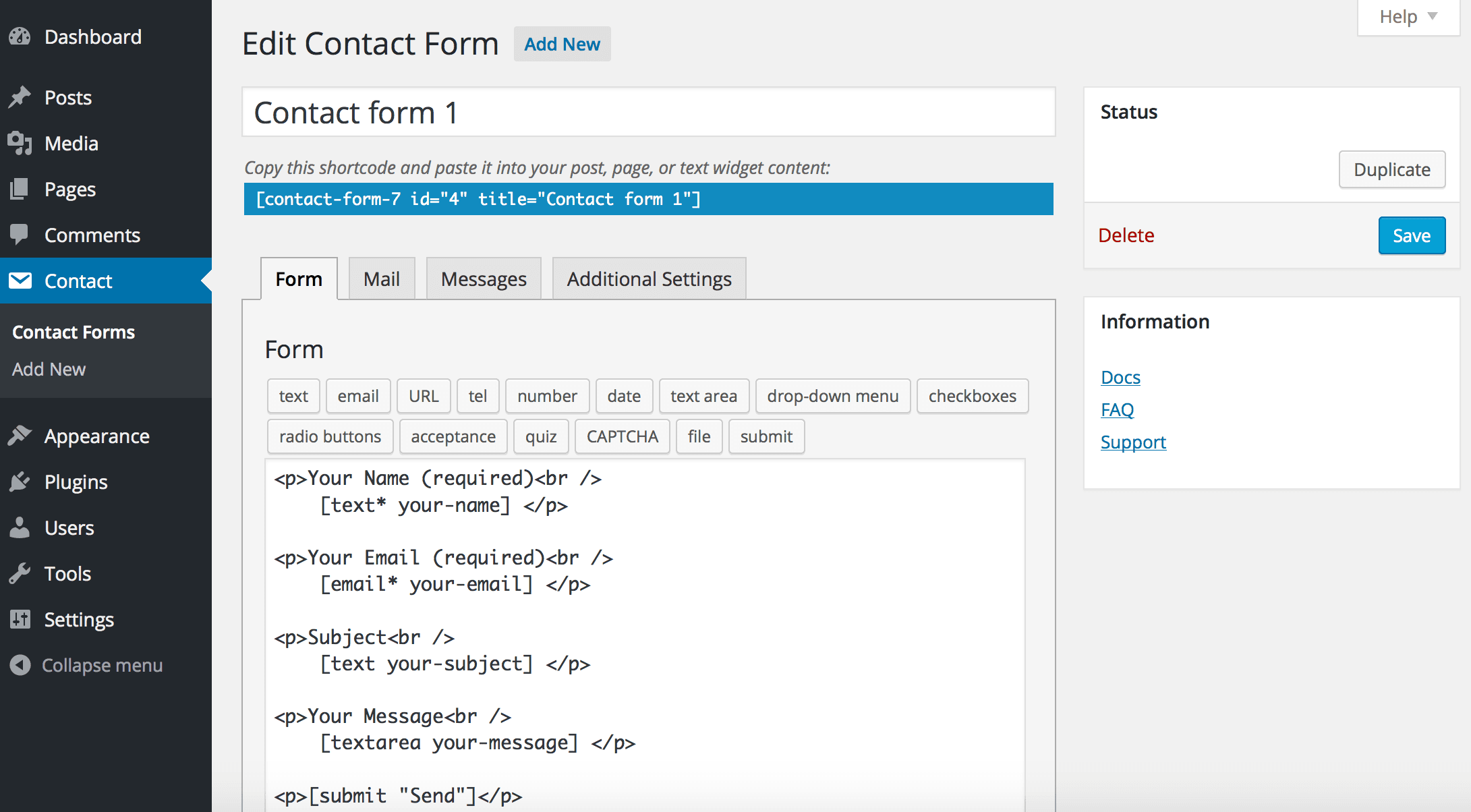
Contact Form 7 Is in Maintenance Mode: What That Actually Means
Contact Form 7's creator confirmed at WordCamp Asia 2026 that version 6.2 is the last feature release — the plugin now gets security patches only. Here's what changes, what doesn't, and what to actually do about it.