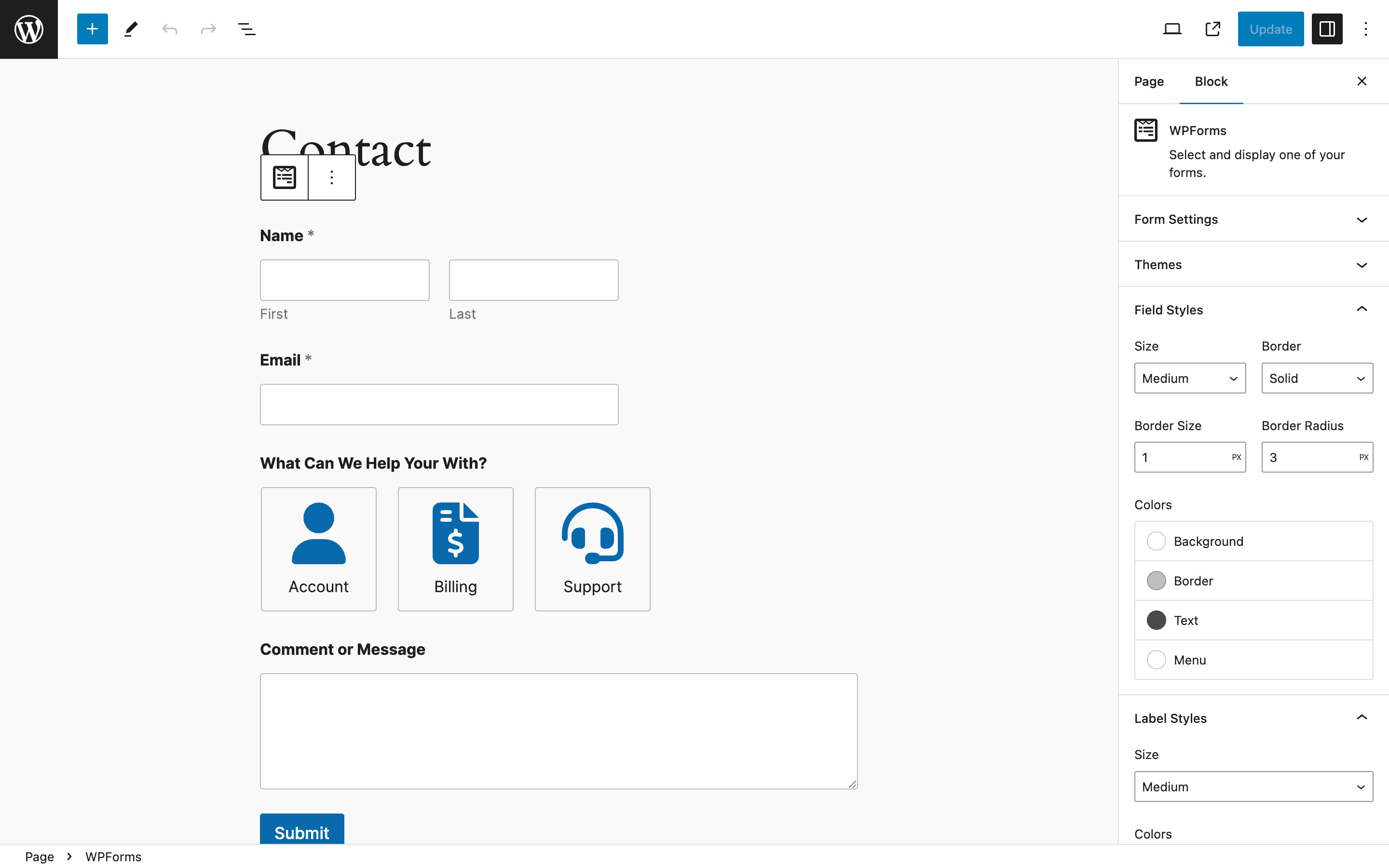
How to Add a Secure File Upload Field to a WordPress Form
A file upload field is one of the more useful things a WordPress form can do — resumes on a job application, documents on an intake form, images on a support request — and also one of the more dangerous if it's built or configured carelessly. This covers how to actually set one up securely, using the specific failure pattern behind a real 2026 vulnerability as the concrete example of what not to do.
Common use cases, and how the risk profile differs
Job application forms — resumes, cover letters, portfolios. Public-facing, often anonymous, high submission volume from unknown senders, making this one of the higher-risk categories: it's exactly the kind of form a broad attack against unpatched sites would target, since job application forms are extremely common and rarely have upload access restricted.
Support and warranty forms — screenshots, photos of a damaged product, log files. Usually lower risk since the sender is often already a known customer, but still worth the same validation discipline, since "usually a known customer" doesn't mean the form itself can distinguish a legitimate customer from an attacker at submission time.
Creative and freelance submission forms — portfolios, writing samples, design files. Often need to accept a broader range of file types (PSD, AI, video files) than a typical resume form, which directly increases the validation surface — broader allowed-type lists mean more file formats that need real content validation, not just extension checking, and more potential formats capable of carrying embedded active content.
Grant and application forms — supporting documents, financial statements, identity verification. Frequently the highest compliance sensitivity of this whole list (see the compliance section below) given the personal and financial nature of what's collected, on top of the same security requirements as any other upload field.
Internal, authenticated-only forms — employee expense receipts, internal document submission. Lowest risk of this group specifically because authentication is already a practical requirement, removing the fully-anonymous attack surface — still worth the same content validation discipline, but the threat model is meaningfully different from a public, anonymous-access form.
Why file upload fields are a common attack target
Every other field type on a form accepts text, which a server can validate and store without much risk regardless of what a visitor types. A file upload field is structurally different: it accepts arbitrary binary content that, depending on how it's handled, can potentially be executed by the server rather than just stored and displayed. An attacker who can upload a file and get the server to execute it as code — a PHP file, most commonly, on a typical WordPress/PHP hosting stack — has a direct path to running arbitrary code on your site, which is about as severe as a web vulnerability gets.
This isn't theoretical. Earlier in 2026, a critical vulnerability (CVE-2026-15748, CVSS 9.8) in Forminator Forms — a plugin with 600,000+ active installs — let a completely unauthenticated attacker upload and execute a PHP file through exactly this mechanism, via a form containing a File Upload field. It's worth understanding precisely what went wrong there before building or auditing your own upload field configuration.
What actually went wrong: a real case study
The Forminator flaw combined two separate weaknesses, and understanding both is more instructive than a generic "validate your uploads" reminder:
- The extension denylist could be bypassed. The plugin blocked dangerous file extensions via an exact-key match against a blocklist — but the check could be defeated using a pipe-alternative MIME type key, a technical quirk in how the validation logic was structured. The lesson generalizes: a denylist implemented with a parsing or matching bug is only as strong as its weakest edge case, and file-type validation logic needs to be tested against deliberately adversarial inputs, not just the expected happy path.
- The upload field's configuration was trusted from the client. The public form-submission handler trusted an upload field's allowed-file-types configuration as submitted, rather than re-verifying it against the form's actual saved configuration server-side. This let an attacker submit a forged Select field value that effectively reconfigured what the upload field would accept, on the fly, for that one malicious submission — bypassing whatever restrictions the form's real owner had actually configured.
Both failures trace back to the same root cause covered in the broader WordPress form security roundup: trusting client-supplied state instead of re-verifying everything meaningful server-side, at the moment of the request.
Setting up a file upload field correctly, step by step
- Add the file upload field to your form in the builder, same as any other field type.
- Set a strict allowed-file-types list — be specific about what the form actually needs (e.g.,
.pdf, .doc, .docxfor a resume upload, or.jpg, .png, .webpfor an image), not a broad "allow most things" default. The narrower the allowlist, the smaller the attack surface, independent of whatever server-side validation exists underneath it. - Confirm the plugin validates actual file content, not just the extension. This is the single most important check — ask directly (or test directly) whether the plugin uses something equivalent to WordPress's own
wp_handle_upload, which checks a file's real MIME type against its actual bytes, rather than trusting the filename's extension string. - Set a reasonable file size limit. Beyond the obvious server-resource reason, an unbounded upload size is itself a denial-of-service vector — a form that accepts unlimited-size uploads can have its endpoint targeted with large files specifically to exhaust server storage or processing capacity.
- Decide where uploaded files get stored, and confirm that location can't execute uploaded files as scripts regardless of extension — the default WordPress uploads directory typically has this protection via server configuration, but a custom storage path (if your plugin supports one) needs the same protection explicitly configured, not assumed.
- Consider requiring login for the form, if the use case allows it — this removes the fully-anonymous, zero-interaction attack surface that made the Forminator flaw exploitable at scale. Not every legitimate use case can require this (a public job application form generally can't), but where it's a reasonable requirement, it's a meaningful risk reduction.
- Test with an actual malicious-pattern file in a safe environment — rename a harmless test file to a blocked extension and confirm it's actually rejected, and separately try uploading a file with a permitted extension but different actual content, to confirm content-based validation is really happening rather than just extension-string matching.
Scanning uploaded files for malware, beyond type validation
Content-type validation confirms a file is genuinely what it claims to be — a real JPEG, a real PDF — but it doesn't confirm the file is free of embedded malicious content, which is a separate concern for higher-risk use cases. A PDF or Office document can carry embedded macros or scripts that a pure MIME-type check won't catch, since the file genuinely is a valid PDF or DOCX, just one with a malicious payload embedded inside a format that legitimately allows active content.
For higher-risk upload forms (broad public submission, higher-value targets, compliance-sensitive contexts), running uploaded files through a malware-scanning service before they're ever served back to anyone is a meaningful additional layer beyond type validation alone — either a self-hosted scanner (ClamAV is a common open-source option) or a third-party scanning API. This is beyond what most WordPress form plugins do natively, and worth evaluating as a deliberate addition for forms where the risk profile justifies it, rather than assuming type validation alone is a complete solution for every use case.
Compliance considerations for uploaded personal documents
A file upload field that collects identity documents, medical records, financial statements, or other sensitive personal data carries data-protection obligations beyond pure security — GDPR (if you have EU visitors), and sector-specific regulations depending on what's being collected, generally require a clear legal basis for collecting the data, a defined retention period rather than indefinite storage, and a documented process for deletion on request. This is a real gap worth checking specifically if your upload form handles this category of document: confirm your form plugin's stored files are actually included in whatever data-deletion process handles the rest of a visitor's data on request, since an uploaded file sitting in a separate storage location from the rest of a form entry can be easy to miss when fulfilling a deletion request otherwise.
What real content-type validation actually checks
"Real" validation means inspecting a file's magic bytes — the first few bytes of a file's actual binary content, which reliably identify its true format regardless of what extension the filename claims. A genuine JPEG always starts with the same specific byte sequence; a PHP script doesn't, no matter what it's named. This is fundamentally different from — and much harder to spoof than — checking whether a filename string ends in .jpg, which is exactly why extension-only validation is considered insufficient on its own by every credible WordPress security resource, and exactly the gap the Forminator vulnerability's denylist-bypass exploited.
Storage location matters as much as validation
Even with airtight upload validation, where the file ends up matters. A file stored in a directory the web server will execute as PHP — because that directory lacks the configuration (commonly an .htaccess rule, or the equivalent at the server level) preventing script execution — turns a successfully-uploaded-but-otherwise-harmless file into a potential compromise the moment it's requested. This is specifically what the Forminator flaw's "Custom File Upload Storage" configuration risk described: the plugin's default storage location had this protection, but an admin-configured custom storage root could be created without it, silently removing a safety net most site owners wouldn't think to check for.
The practical rule: whatever directory holds uploaded files, verify directly (not assume) that requesting a .php file from that directory via URL doesn't execute it — a quick, cheap test that directly confirms the protection you're relying on actually exists.
Rate limiting and abuse prevention beyond file validation
File-type and content validation stop a malicious file from being accepted at all, but a separate concern is volume-based abuse — a form being hit with a high rate of upload attempts, valid file type or not, aimed at exhausting storage, bandwidth, or processing capacity rather than at getting a malicious file accepted. This overlaps with the broader AI bot spam problem covered elsewhere, but upload endpoints specifically deserve extra attention since a spam submission with a file attached costs meaningfully more in storage and bandwidth than a spam submission that's just text.
Practical mitigations worth layering on top of type/content validation specifically for upload-carrying forms: a per-IP or per-session submission rate limit (most WAFs and some hosting platforms support this natively), a CAPTCHA or behavior-scoring challenge specifically gating the upload step rather than just the overall form, and periodic storage-usage monitoring so an abuse pattern shows up as an anomalous storage growth rate before it becomes a full disk-space incident.
A quick audit checklist for existing forms
If you already have file upload fields live on a site, worth auditing now rather than waiting for the next disclosed CVE to prompt it:
- List every form with a file upload field, and note the plugin version currently installed against its latest security-patched version.
- For each, confirm the allowed file types are actually narrow and specific, not a broad default.
- Confirm (don't assume) that the storage location can't execute uploaded files — test directly as described above.
- Confirm file size limits are set to something reasonable for the actual use case, not left unbounded.
- If any form combines a file upload field with a Select or dropdown field on the same form, treat that combination as slightly higher priority to audit specifically, given that's the exact field combination the 2026 Forminator vulnerability required to be exploitable.
Signs a file upload field may already be compromised
If you're auditing an existing site rather than building new, a few concrete things worth checking beyond configuration review:
- Unexpected files in the uploads directory. Browse (via FTP/SFTP or a file manager, not just the WordPress media library, which only shows what it knows about) the actual upload storage directory for files that don't match what your forms should be collecting — a
.phpfile sitting in a directory meant for resumes or images is an immediate red flag, not something to investigate later. - Unexplained storage growth. A sudden, unexplained increase in disk usage on an upload-heavy site is worth investigating directly rather than just clearing space — it can indicate either legitimate growth or bulk abusive uploads.
- Unfamiliar admin users or scheduled tasks. A successful file-upload compromise often leads to a follow-on step (creating a hidden admin account, scheduling a cron-based backdoor) — reviewing the WordPress users list and any scheduled tasks/cron jobs is a reasonable follow-up check if an upload-related compromise is suspected.
- Outbound traffic your site shouldn't be generating. A compromised site is sometimes repurposed to send spam email or participate in further attacks — unusual outbound traffic patterns, if your host provides that visibility, is a signal worth investigating.
If any of these turn up something concrete, treat it as an active incident (change all credentials, restore from a known-clean backup if one predates the compromise, and only then re-audit the upload configuration) rather than just patching the immediate finding and assuming that's sufficient — a confirmed compromise usually warrants a broader cleanup than fixing the single entry point.
The bottom line
A file upload field is genuinely useful and doesn't need to be avoided, but it's the one field type on a typical WordPress form that can turn a form-security oversight into full site compromise, which is why it deserves more scrutiny than a text field does. Real content-type validation (not extension matching), a hard denylist that a form's own configuration can't override, sensible size limits, and confirmed-safe storage cover the real risk surface. ChargeForms' own upload handling follows this pattern specifically — validated through WordPress's own wp_handle_upload, with a hard executable-file denylist independent of a form's configured allowlist — detailed on the Security page alongside the rest of the platform's security architecture.
Frequently asked questions
Is it safe to let visitors upload files through a WordPress form?
Yes, if the upload field is configured correctly — real MIME-type validation (checking actual file content, not just the filename extension), a hard denylist of executable file types, reasonable file-size limits, and files stored somewhere that can't execute PHP. It's not safe with a naive implementation that only checks the filename extension, which is exactly the class of flaw behind a critical 2026 vulnerability (CVE-2026-15748) in a major WordPress form plugin.
What file types should I never allow in a WordPress upload field?
Executable and server-side script types: .php, .php3-.php8, .phtml, .pht, .phar, .cgi, .pl, .py, .asp, .aspx, .sh, .exe, .js (as a standalone upload, not inline in a document), and any other extension a server might execute rather than just serve as a static file. A well-built upload field blocks these at a hard denylist level regardless of what a form's own field configuration allows, specifically so a misconfigured or forged field can't override the block.
Why isn't checking the file extension enough to secure an upload field?
A file's extension is just a naming convention an attacker fully controls — renaming a malicious PHP file to end in .jpg doesn't change its actual content. Real security requires checking the file's actual content type (MIME type via its magic bytes/signature, not the filename), which is what WordPress's own wp_handle_upload function does, rather than trusting the extension string alone.
Where should uploaded files be stored on a WordPress site?
Outside the web-executable document root if possible, or in a directory with server configuration (like an .htaccess rule) that prevents any file in it from being executed as a script regardless of its extension. If files must be publicly accessible via URL, make sure the storage directory itself can't execute code -- this is exactly the layer that failed in Forminator's 2026 vulnerability, where a custom storage configuration could be set up without that protection.
Should I require login before allowing a file upload?
It depends on the use case, but it measurably reduces risk when possible -- requiring authentication before a visitor can reach an upload field removes the fully-anonymous, no-interaction attack surface that made CVE-2026-15748 so severe (a completely unauthenticated attacker could exploit it). For public-facing forms where anonymous uploads are the actual requirement (a general application form, for instance), the file-type and content validation layers matter even more since you can't rely on authentication as an additional filter.
Related posts
Contact Form 7 Is in Maintenance Mode: What That Actually Means
Contact Form 7's creator confirmed at WordCamp Asia 2026 that version 6.2 is the last feature release — the plugin now gets security patches only. Here's what changes, what doesn't, and what to actually do about it.