7 Best Gravity Forms Alternatives in 2026 (Including Free Options)
Gravity Forms is one of the most respected WordPress form plugins among developers, largely because of its deep extensibility and mature add-on ecosystem. It's also the only major plugin in this category with no free tier whatsoever — every single feature, including a basic contact form, requires a paid license starting at $59/year. That's the single most common reason people go looking for an alternative, and this covers the real options, with sourced pricing and feature data.
Why Gravity Forms has no free tier, and what that actually means
Gravity Forms' business model is straightforward: it's a premium-only product, positioned toward agencies and developers already willing to pay for reliable, extensible tooling. There's no "Lite" version on WordPress.org the way WPForms or Fluent Forms offer — you can't install it and try it without a license key and a payment first. This isn't a limitation exactly, it's a deliberate positioning choice, but it does mean anyone comparing form plugins by installing a few free options to test first will never get to try Gravity Forms that way.
"No payment fee" = no percentage markup on top of Stripe's own rate. Note the pattern: every free-tier plugin except ChargeForms either has a fee (Fluent Forms, WPForms) or doesn't include payments free at all (Ninja Forms, Formidable) — Gravity Forms avoids the fee but requires payment for everything, including the free-tier alternatives' most basic functionality.
The alternatives, compared
1. Fluent Forms
The closest match to Gravity Forms on feature depth while still having a genuine free tier. Conditional logic, a large field library, and basic multi-step forms are all free; Stripe payments are free with a 1.9% platform fee.
Pricing: Free forever / $79/yr (1 site) / $159/yr (5 sites) / $299/yr (unlimited).
Best for: Sites that want Gravity Forms-adjacent capability without the mandatory upfront cost, and don't mind the Stripe fee at low-to-moderate payment volume.
Strengths: the most generous free tier of any Gravity Forms-adjacent competitor, deep conditional logic (nested AND/OR/NOT) even on free, and tight integration with other WPManageNinja products if you're already using FluentCRM. Trade-offs: a steeper builder learning curve than WPForms for a first-time user, and its add-on/integration ecosystem, while solid, doesn't match Gravity Forms' years of accumulated third-party development.
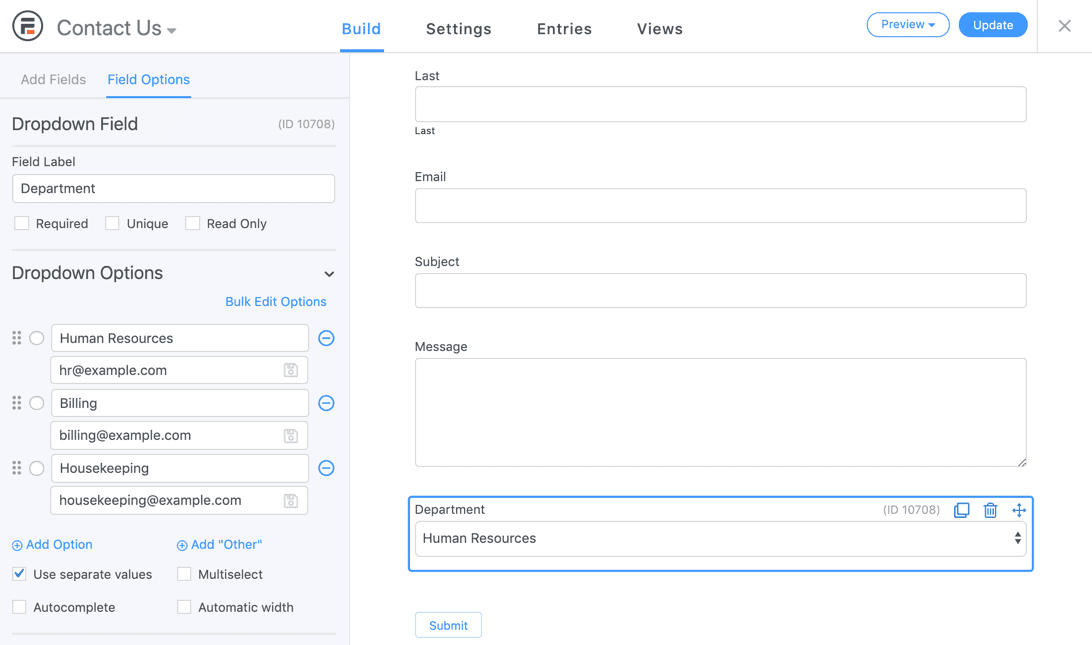
2. WPForms
The most beginner-friendly option here, with the largest template library in the category. Free "Lite" plan is limited (no conditional logic, no payments), but paid tiers are well-documented and broadly used.
Pricing: Free Lite / $99/yr (Basic, 1 site) / $199/yr (Plus, 3 sites) / $399/yr (Pro, 5 sites) / $599/yr (Elite, unlimited).
Best for: Non-technical users who want the gentlest possible learning curve and don't need Gravity Forms' developer-focused extensibility.
Strengths: the largest pre-built template library in the category, extensive documentation, and a support ecosystem built over many years. Trade-offs: Lite's restrictions (no logic, no payments, no file uploads) push most real use cases toward a paid tier fairly quickly, and its own paid pricing runs higher than several competitors at comparable site-count tiers.
3. Ninja Forms
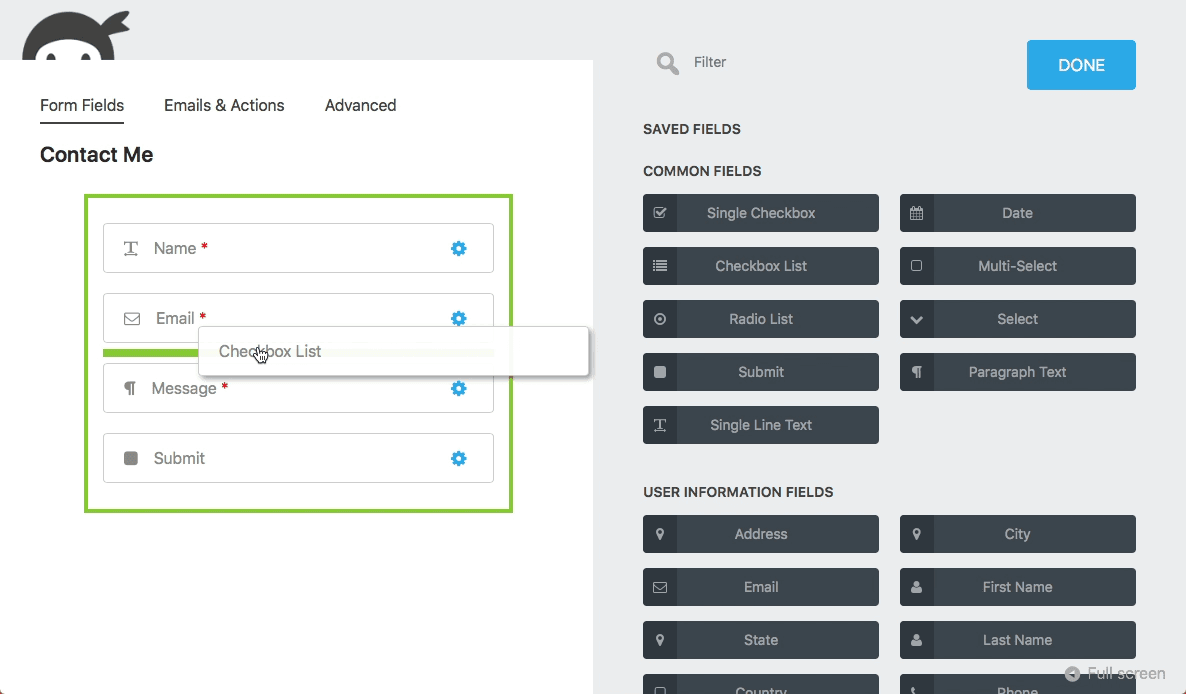
A genuinely complete free "Core" plugin — unlimited forms, unlimited site installs, a real drag-and-drop builder — with no percentage fee on payments once you do upgrade for that feature.
Pricing: Free Core / $99/yr (3 sites) / $199/yr (20 sites) / $499/yr (unlimited).
Best for: Budget-conscious builds that can start free and grow into a paid plan only once payments or deeper logic are actually needed.
Strengths: unlimited site installs even on the free Core plugin — genuinely uncommon among competitors, most of which either cap free-tier sites or don't specify. No percentage fee once you do pay for payment support. Trade-offs: the free-to-paid feature jump is fairly steep — conditional logic and payments both require an upgrade, which narrows how far "genuinely free" actually gets you beyond a basic form.
4. Formidable Forms
Leans toward complex, data-heavy use cases beyond a standard contact form — calculations, front-end data display via "Views," directories built from submitted entries. This overlaps meaningfully with why some developers reach for Gravity Forms in the first place: both handle complexity most simpler form plugins don't attempt.
Pricing: Free / $79/yr (1 site) / $199/yr (3 sites) / $399/yr (7 sites) / $599/yr (unlimited).
Best for: Directories, calculators, and front-end content submission workflows — the segment of Gravity Forms' typical use case that's about structured data, not just lead capture.
Strengths: the "Views" feature (displaying submitted entry data back on the front end as a directory, listing, or leaderboard) is a genuinely differentiated capability few competitors directly replicate, including Gravity Forms itself without a separate add-on. Trade-offs: payments require the Business tier and up, and the extra builder surface area for calculations/views is more complexity than a team needing a simple contact form actually wants.
5. ChargeForms
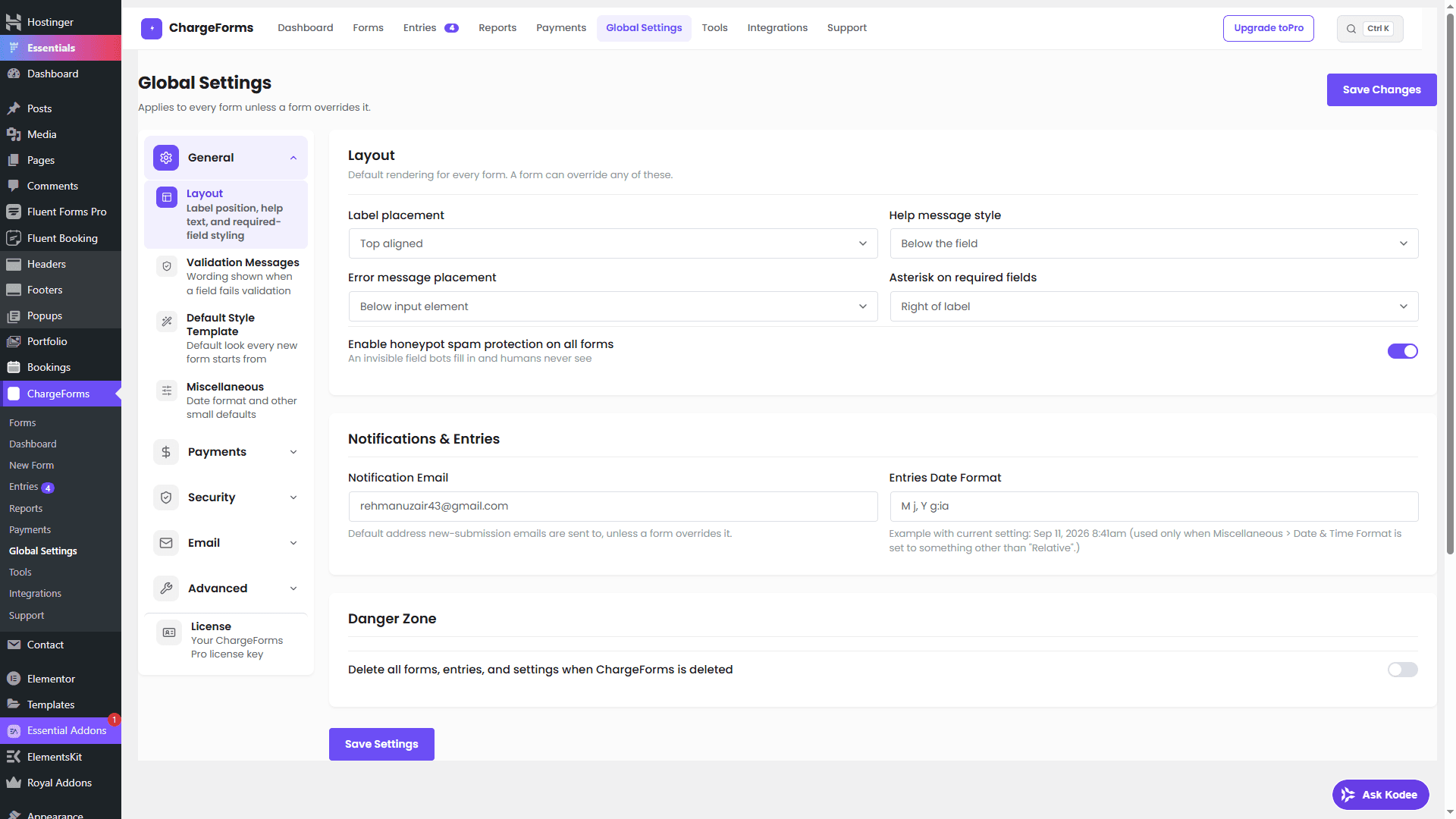
Free plan includes conditional logic (nested AND/OR/NOT), Stripe and PayPal payments, multi-step forms, and CSV export — with $0 platform fee on payments at any tier.
Pricing: Free forever / $69/yr (1 site) / $139/yr (5 sites) / $259/yr (unlimited) — see the full comparison against Gravity Forms specifically.
Best for: Sites that want Gravity Forms' free-of-payment-fee model, without also requiring a paid license just to build a basic form.
Strengths: the only option in this list combining a genuine free tier, conditional logic, and payments with zero platform fee all at once — every payment amount is also recalculated server-side rather than trusted from the client, closing a tampering vector some plugins leave open. Trade-offs: newer to market than the established competitors here, so a smaller existing add-on ecosystem than Gravity Forms has built over years; PayPal subscriptions aren't implemented yet (Stripe subscriptions are, free on any plan).
6. JetFormBuilder
Part of the Crocoblock/JetPlugins ecosystem, built specifically around the WordPress block editor rather than a separate builder interface. Free core plugin with paid add-ons for advanced features including payment processing.
Best for: Sites already invested in the JetPlugins ecosystem (JetEngine, JetElements) wanting a form builder that shares that same block-based workflow.
Strengths: native block-editor integration feels more modern and consistent with core WordPress than a separate builder interface bolted onto wp-admin. Trade-offs: its ecosystem and community are smaller than the more established plugins in this list, and it's most compelling specifically for sites already using other Crocoblock products rather than as a standalone pick.
7. Contact Form 7 (with add-ons)
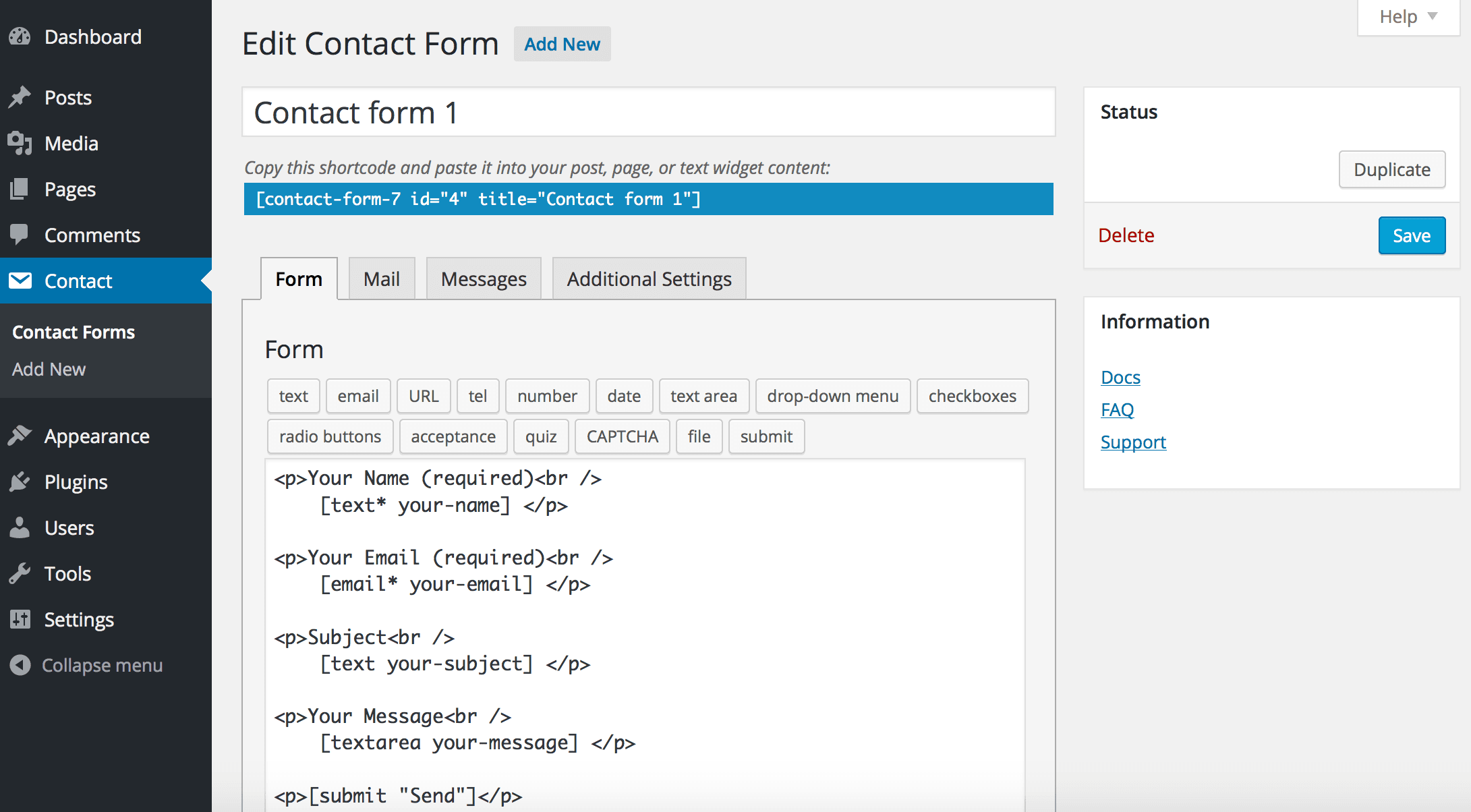
The oldest, most widely-installed free WordPress form plugin by raw install count, though it's genuinely minimal on its own — conditional logic, payments, and multi-step support all require third-party add-ons of varying quality and maintenance status, rather than being built in.
Best for: Developers comfortable assembling functionality from separate add-ons, or a genuinely bare-minimum contact form with no further requirements.
Strengths: enormous install base and community, genuinely free with no feature-gated upsell pressure, since it isn't really trying to be a full-featured builder in the first place. Trade-offs: the add-on quality and maintenance status varies significantly by developer, since they're third-party rather than officially maintained the way a plugin's own paid tiers are — worth vetting each add-on's update history before relying on it for something business-critical like payments. See the full Contact Form 7 alternatives comparison if that's the specific migration you're deciding on, including why it doesn't save submissions anywhere by default.
Pricing side by side
"Cheapest tier that includes payments" — for the free options, this shows $0 since payment collection is included on the free plan (with or without a platform fee, noted per label). Gravity Forms requires its Basic tier ($59/yr) minimum before any feature, including a plain contact form, works at all.
How these were evaluated
Every pricing figure above is each vendor's own currently-published regular annual list price, gathered directly from their own pricing pages rather than third-party aggregators or promotional rates. Free-tier feature claims are checked against each plugin's own current documentation rather than a general marketing summary, since what's prominently advertised on a homepage doesn't always specify which license tier it actually requires — a distinction that matters most for the exact comparison this article is making.
What to actually check before switching
- Does the free tier of the alternative include what's actually driving you away from Gravity Forms' cost — payments, conditional logic, a specific field type? Confirm against current documentation rather than a general feature list, since free-tier scope changes over time.
- Do you rely on Gravity Forms-specific add-ons or a custom integration built on its hooks? This is the single biggest switching cost for existing Gravity Forms users specifically — its add-on ecosystem and developer API are its strongest differentiator, and a custom-built integration doesn't port automatically to a different plugin's hook system.
- Is a percentage payment fee a dealbreaker at your volume? Gravity Forms and ChargeForms both avoid this; Fluent Forms and WPForms don't on their lower tiers — run the math with your own payment volume rather than assuming any specific plugin is automatically cheaper once its own tier requirements are factored in.
- Export your existing entries to CSV before switching anything — no plugin here offers a true one-click migration from Gravity Forms specifically, and having a backup of historical submission data before touching anything is cheap insurance regardless of which alternative you choose.
Choosing by use case
If you're deciding based on a specific need rather than a general comparison, these tend to map cleanly:
- Simple contact form, zero budget, no payments needed: Ninja Forms Core, or Contact Form 7 if you're comfortable with third-party add-ons for anything beyond the basics.
- Need conditional logic free, payments can wait: Fluent Forms.
- Need payments free with zero platform fee: ChargeForms.
- Building a directory, calculator, or front-end data display: Formidable Forms.
- Already committed to the block editor and JetPlugins ecosystem: JetFormBuilder.
- Want the gentlest learning curve and largest template library, budget isn't the constraint: WPForms.
- Deep custom integrations, an existing add-on investment, or agency-scale reliability requirements where cost isn't the deciding factor: Gravity Forms remains the right call, covered in more detail below.
Actually migrating away from Gravity Forms
If you've decided to switch, the practical steps:
- Export existing entries to CSV first, before touching anything else — this preserves historical submission data regardless of what happens next, and costs nothing to do even if you end up not needing it.
- Document your current forms' field configuration and conditional logic rules before rebuilding — screenshot or write down each form's structure in the old plugin, since you'll be recreating it from scratch in the new one, not migrating it automatically.
- Rebuild forms manually in the new plugin rather than searching for an automated migration tool — cross-plugin form-structure migration is inconsistent at best for simple forms and effectively doesn't exist for anything using Gravity Forms' more advanced conditional logic or calculated fields, which don't have a direct equivalent to map onto in every alternative.
- Re-test every integration explicitly — payment gateway connections, email notifications, any Zapier/Make automation tied to a Gravity Forms webhook or add-on — none of these carry over automatically, even when the visible form itself looks identical in the new builder.
- Update embedded shortcodes and blocks on every page referencing the old Gravity Forms shortcode — this is the step most commonly missed, surfacing as a broken or missing form discovered by a visitor rather than caught during testing.
- Keep Gravity Forms installed but deactivated for a short overlap period rather than uninstalling immediately, in case you need to reference the original configuration while finishing the rebuild.
Why "no free tier" specifically pushes people to look elsewhere
It's worth being precise about what's actually driving this search, since it shapes which alternative makes sense. It's rarely that Gravity Forms is seen as a bad product — its reputation for reliability and extensibility is genuinely earned. The friction is almost always about evaluation cost: a team wanting to test whether a form plugin fits their workflow before committing budget to it can't do that with Gravity Forms the way they can with five other options on this list, all of which offer a real, no-time-limit free tier to build and test against before any purchase decision. For a solo site owner or a small business without an existing developer relationship guiding the choice, that evaluation friction alone is often enough to end the search at a free alternative before Gravity Forms' actual feature depth ever gets a fair comparison.
Who should stick with Gravity Forms
Despite everything above, Gravity Forms remains the right call for a specific, real segment: teams with an existing investment in its add-on ecosystem, developers who value its mature hook-based API for custom integrations, or agencies managing many client sites where Gravity Forms' reliability track record and support quality outweigh the upfront cost. The free-tier alternatives above solve the "I don't want to pay before I can even try a form plugin" problem specifically — they don't automatically out-develop Gravity Forms' years of accumulated third-party ecosystem for a team that's already built real workflows on top of it.
The bottom line
If the core issue is "I don't want to pay before I can build a single form," every option in this list except Gravity Forms itself solves that directly. If payments-without-a-fee specifically matters alongside that free tier, ChargeForms is the only option combining both; if deep developer extensibility is what actually draws you to Gravity Forms in the first place, none of the free alternatives fully replicate that yet, and Gravity Forms (or Formidable Forms, the closest competitor on data-handling depth) may remain the right tool despite the cost. See the direct ChargeForms vs. Gravity Forms breakdown for the specific feature-by-feature detail.
Frequently asked questions
Is there a free version of Gravity Forms?
No. Gravity Forms has never offered a free tier — every plan requires payment starting at Basic ($59/year for 1 site), unlike WPForms, Fluent Forms, Ninja Forms, Formidable Forms, and ChargeForms, all of which have a genuine free plan you can use indefinitely.
What is the best free alternative to Gravity Forms?
It depends on what you need. ChargeForms' free plan includes conditional logic and Stripe/PayPal payments with no platform fee. Fluent Forms' free plan includes conditional logic and Stripe payments (with a 1.9% fee). Ninja Forms' free "Core" plugin is a solid builder but doesn't include payments without a paid add-on.
Why would someone choose Gravity Forms over a free alternative?
Gravity Forms has the most mature third-party add-on ecosystem and deepest hook-based developer extensibility of any plugin in this comparison, which matters significantly for complex custom integrations. For a straightforward contact, lead-gen, or payment form, a free alternative usually covers the need without the mandatory cost.
Can I migrate my existing Gravity Forms to a different plugin?
There's no universal one-click migration between form plugins, including away from Gravity Forms -- most sites rebuild forms manually in the new builder, which is usually faster than debugging an imperfect automated migration tool, especially for straightforward contact and lead-gen forms. Export existing entries to CSV first, before switching, so historical submission data isn't lost in the transition.
Does Gravity Forms charge a fee on payments like some other plugins do?
No -- Gravity Forms doesn't add a percentage markup on top of Stripe's own processing rate, unlike Fluent Forms (1.9%) or WPForms (3%) on their lower tiers. The tradeoff is that Gravity Forms requires a paid plan before payments (or any feature) work at all, so 'no fee' comes bundled with a mandatory purchase rather than free access.
Related posts
Contact Form 7 Is in Maintenance Mode: What That Actually Means
Contact Form 7's creator confirmed at WordCamp Asia 2026 that version 6.2 is the last feature release — the plugin now gets security patches only. Here's what changes, what doesn't, and what to actually do about it.